Image Details

Choose export citation format:

The Initial Mass Function Based on the Full-sky 20 pc Census of ∼3600 Stars and Brown Dwarfs

  • Authors: J. Davy Kirkpatrick, Federico Marocco, Christopher R. Gelino, Yadukrishna Raghu, Jacqueline K. Faherty, Daniella C. Bardalez Gagliuffi, Steven D. Schurr, Kevin Apps, Adam C. Schneider, Aaron M. Meisner, Marc J. Kuchner, Dan Caselden, R. L. Smart, S. L. Casewell, Roberto Raddi, Aurora Kesseli, Nikolaj Stevnbak Andersen, Edoardo Antonini, Paul Beaulieu, Thomas P. Bickle, Martin Bilsing, Raymond Chieng, Guillaume Colin, Sam Deen, Alexandru Dereveanco, Katharina Doll, Hugo A. Durantini Luca, Anya Frazer, Jean Marc Gantier, Léopold Gramaize, Kristin Grant, Leslie K. Hamlet, Hiro Higashimura, 村 滉 東, Michiharu Hyogo, Peter A. Jałowiczor, Alexander Jonkeren, Martin Kabatnik, Frank Kiwy, David W. Martin, Marianne N. Michaels, William Pendrill, Celso Pessanha Machado, Benjamin Pumphrey, Austin Rothermich, Rebekah Russwurm, Arttu Sainio, John Sanchez, Fyodor Theo Sapelkin-Tambling, Jörg Schümann, Karl Selg-Mann, Harshdeep Singh, Andres Stenner, Guoyou Sun, 国佑 孙, Christopher Tanner, Melina Thévenot, Maurizio Ventura, Nikita V. Voloshin, Jim Walla, Zbigniew Wędracki, Jose I. Adorno, Christian Aganze, Katelyn N. Allers, Hunter Brooks, Adam J. Burgasser, Emily Calamari, Thomas Connor, Edgardo Costa, Peter R. Eisenhardt, Jonathan Gagné, Roman Gerasimov, Eileen C. Gonzales, Chih-Chun Hsu, Rocio Kiman, Guodong Li, Ryan Low, Eric Mamajek, Blake M. Pantoja, Mark Popinchalk, Jon M. Rees, Daniel Stern, Genaro Suárez, Christopher Theissen, Chao-Wei Tsai, Johanna M. Vos, David Zurek

J. Davy Kirkpatrick et al 2024 The Astrophysical Journal Supplement Series 271 .

  • Provider: AAS Journals

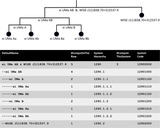
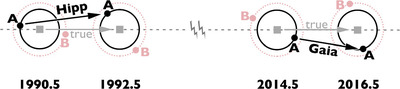
Caption: Figure 3.

Schematic diagram demonstrating the concept of proper-motion anomaly. A binary star system, comprised of an A component (solid black orbit and black points) and a lower-mass B component (dotted pink orbit and pink points) is shown at four separate times corresponding to approximate start and end dates of Hipparcos (left pair) and Gaia DR2 (right pair). The center of mass (gray squares) moves from left to right over time, and the true proper motion of the system over the Hipparcos and Gaia timeframes is represented by the two gray arrows. Assuming that the A component dominates the light of the system, neither Hipparcos nor Gaia will measure this true motion because the center of light will move with component A as the stars orbit their barycenter. The black arrow at left thus shows the proper motion that would be measured by Hipparcos, and the black arrow at right shows the motion measured by Gaia DR2. The disagreement between these two independent measurements is termed proper-motion anomaly and provides evidence that the system has an unseen component. (For simplicity, we have removed parallactic motion by showing only those points at the same parallax factor, as depicted by the time stamps at the bottom of the figure.)

Other Images in This Article

Show More

Copyright and Terms & Conditions

Additional terms of reuse