

Image Details
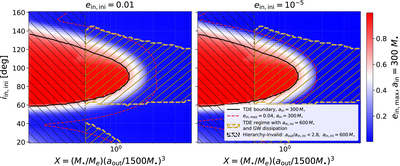
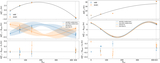
Caption: Figure 3.
Left: survival map of a star in the (iin,ini, X) plane for a fiducial EMRI configuration motivated by the typical orbital scale of GSN 069. The color indicates the maximum inner orbital eccentricity ﹩{e}_{{\rm{in}},{\rm{\max }}}﹩ reached during the SA evolution, including octupole-order terms and 1PN relativistic apsidal precession. The calculation uses M• = 4 × 10⁵ M⊙, ain = 300 M•, ein,ini = 0.01, and a circular outer orbit with eout = 0. For each displayed point, the plotted value is the largest ﹩{e}_{{\rm{in}},{\rm{\max }}}﹩ obtained after sampling a logarithmic grid of tertiary SMBH masses 105 ≤ Me/M⊙ ≤ 106 and eight initial values of ωin, subject to the hierarchy cut aout/ain ≥ 2.8. The black solid contour denotes the TDE boundary ﹩{a}_{{\rm{in}}}(1-{e}_{{\rm{in}},{\rm{\max }}})={r}_{{\rm{TDE}}}﹩, and the red dashed contour denotes ﹩{e}_{{\rm{in}},{\rm{\max }}}=0.04﹩. Regions enclosed by the TDE boundary would tidally disrupt a solar-type star and are therefore disfavored if the observed QPE source contains a surviving star. Right: same as the left panel, but with a much lower initial inner orbital eccentricity ein,ini = 10−5. The yellow shaded regions in both panels denote the TDE regime obtained from a rescan of the same (Me, aout) grid with ain,ini = 600M• and GW dissipation.
Other Images in This Article
Copyright and Terms & Conditions
© 2026. The Author(s). Published by the American Astronomical Society.

