

Image Details
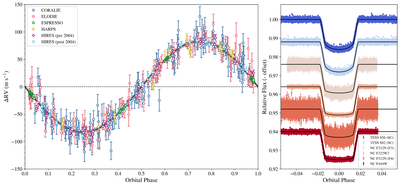
Caption: Figure 1.
Left: the phase-folded radial velocities (RVs) for the different spectroscopic instruments used in this work. The best-fit Keplerian model for a circular orbit from our juliet fit is shown as a solid black curve, with 1σ intervals shaded in gray. The uncertainties shown account for the jitter term, σw. Systemic velocity offsets were applied to bring all RV datasets to a common zero-point, marked by a horizontal dashed line. (The offsets and original datasets are available at https://dace.unige.ch/radialVelocities/?pattern=hd%20209458.) Right: the phase-folded transit light curves for the different instrument used in this work. The best-fit model for a circular orbit from our juliet fit is shown as a solid black curve. “SC” corresponds to the short-cadence mode of TESS. “NC” corresponds to JWST NIRCam. The two short-wavelength (SW) NIRCam F212N light curves are denoted as F3 and F4 to signify their simultaneous acquisition alongside the adjacent long-wavelength (LW) F322W2 and F444W observations, respectively.
Other Images in This Article
Copyright and Terms & Conditions
© 2026. The Author(s). Published by the American Astronomical Society.

