

Image Details
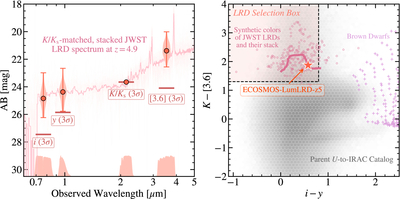
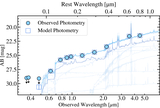
Caption: Figure 1.
Left: the spectra of JWST LRDs from D. J. Setton et al. (2025b) and R. E. Hviding et al. (2025) are shifted to z = 4.9, matched to the K/Ks-band 3σ limit (23.7 mag), and stacked together. Synthetic photometry of the stack (circles) and of each individual LRD in the stack (violins) both demonstrate that, after applying the K/Ks cut, the photometry of all selection bands would lie above their respective survey depth limits (horizontal lines), suggesting our search for the luminous LRDs is plausibly volume complete. Right: the synthetic photometric colors of 38 spectroscopically selected LRDs from D. J. Setton et al. (2025b) and R. E. Hviding et al. (2025) are shown as pink circles in the LRD selection box. The colors are computed by shifting the 38 LRD spectra to 4.5 < z < 4.9 with a Δz = 0.1 increment. We also show color evolution with redshift of the stacked LRD spectrum between 4.5 < z < 4.9 (from left to right). The one LRD candidate (ECOSMOS-LumLRD-z5) that we identify in this work is shown as the star. The full parent u-to-IRAC catalog is shown in the background, and synthetic colors of a suite of brown dwarfs (generated from the A. M. Meisner et al. 2021 templates) are shown as magenta crosses.
Other Images in This Article
Copyright and Terms & Conditions
© 2026. The Author(s). Published by the American Astronomical Society.

