

Image Details
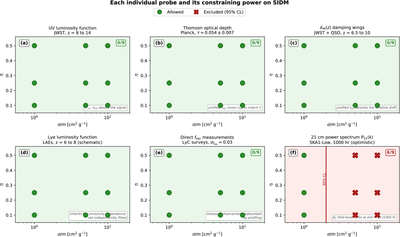
Caption: Figure 3.
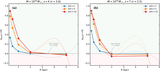
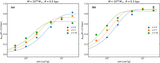
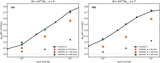
Probe-by-probe sensitivity to SIDM in the (σ/m, η) plane. Each panel shows the constraint from a single observable. Green circles: consistent with data; red crosses: exclusion at 95% confidence. (a) UVLF: no exclusion (Δχ2 < 0.21; Z. Wang & H. Shan 2026a). (b) Planck τ: fesc absorbs the shift. (c) JWST ﹩{\bar{x}}_{{\rm{HI}}}(z)﹩: a single profiled fesc absorbs most of the timeline shift. (d) Lyα LF: inherits the same product degeneracy (illustrative; no separate Lyα likelihood is fitted). (e) LyC measurements + blowout correlation (﹩{\sigma }_{{f}_{{\rm{esc}}}}=0.03﹩, αesc = 0.3) does not break the degeneracy; once fesc is profiled, 0/9 points are excluded. (f) 21 cm power spectrum with SKA1-Low: structurally immune to the product degeneracy; the six points with σ/m ≥ 2 cm2 g−1 are excluded at >5σ with 1000 hr per pointing under optimistic foregrounds (Appendix F). A field-level forecast for the topology statistic β0 itself gives 2.0σ at σ/m = 10 cm2 g−1 (1000 hr) and 4.1σ at 5000 hr (σ/m = 5: 2.9σ).
Other Images in This Article
Copyright and Terms & Conditions
© 2026. The Author(s). Published by the American Astronomical Society.

