

Image Details
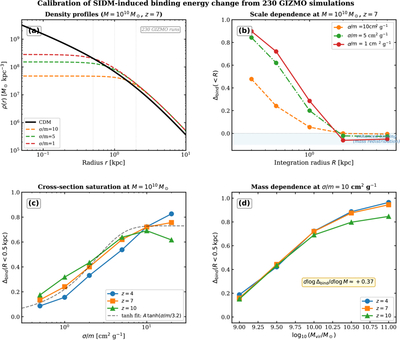
Caption: Figure 2.
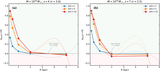
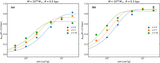
Calibration of the SIDM-induced binding energy change from 230 GIZMO simulations. (a) Dark matter density profiles for an M = 1010 M⊙ halo at z = 7 with σ/m = 0 (CDM, solid black curve) and σ/m = 1, 5, 10 cm2 g−1 (dashed colored curves). SIDM thermalizes the inner halo, replacing the NFW cusp with an isothermal core. (b) Scale dependence of ﹩{{\rm{\Delta }}}_{{\rm{bind}}}(\lt R)=1-{W}_{g}^{{\rm{SIDM}}}/{W}_{g}^{{\rm{CDM}}}﹩ for the same halo. The central reduction (24%–72% at R < 0.5 kpc) transitions to enhanced binding at R ≳ 2 kpc where mass redistribution dominates. This reconciles our framework with reports of conserved total binding energy (Y.-Y. Wang et al. 2026). (c) The Δbind(σ/m) relation saturates above σ/m ∼ 5 cm2 g−1, well described by ﹩{{\rm{\Delta }}}_{{\rm{bind}}}=A\tanh (\sigma /m/{\sigma }_{{\rm{crit}}})﹩. (d) Mass dependence at σ/m = 10 cm2 g−1. The slope ﹩d\mathrm{log}{{\rm{\Delta }}}_{{\rm{bind}}}/d\mathrm{log}M\approx +0.37﹩ at z = 7 means the SIDM modification is strongest in the comparatively massive halos that dominate both the observed UVLF and, in our calibrated model, the ionizing emissivity.
Other Images in This Article
Copyright and Terms & Conditions
© 2026. The Author(s). Published by the American Astronomical Society.

