

Image Details
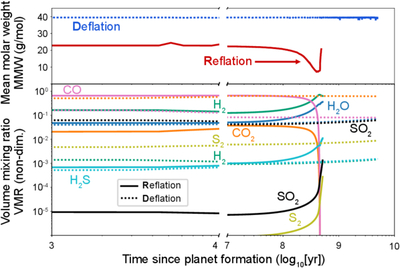
Caption: Figure 2.
Evolution of atmospheric composition for the labeled reflation (solid lines) and deflation (dashed lines) cases from Figure 1 (R and D). Top panel: evolution of the atmospheric mean molar weight. Bottom panel: the volume mixing ratio of the dominant molecules in the planets’ atmospheres. The reflation simulation loses its primary atmospheric gas (CO, colored pink) through hydrodynamic escape. Until this point, the H molecules of the reflation case are dominantly dissolved as H2O in the underlying magma ocean, and outgassed to the atmosphere as the CO-dominated envelope escapes to space. This transition from C- to H-dominated atmosphere reinflates the atmosphere (through the decrease in MMW) and reduces the observed bulk density of the planet transiently by up to 60%.
Other Images in This Article
Copyright and Terms & Conditions
© 2026. The Author(s). Published by the American Astronomical Society.

