

Image Details
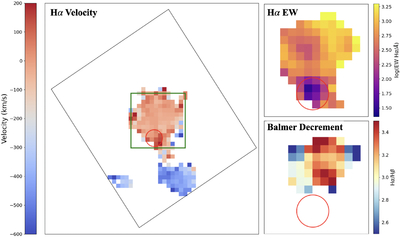
Caption: Figure 3.
Hα velocity, EW, and Balmer decrement maps of LACES104037. The left panel shows the velocity distribution of the LACES104037 merger system, primarily consisting of three distinct components. We adopt the redshift of LACES104037-bulk as the zero-point and compute the velocity field of the entire system, which clearly reveals the relative velocity offsets among the three components. The black box indicates the JWST NIRSpec IFU FoV, while the green box marks the spatial coverage of the panels shown on the right. The top right panel presents the spatial distribution of Hα EW in LACES104037. The Hα EW distribution within LACES104037-bulk is highly inhomogeneous, suggesting substantial differences in stellar population properties among individual star-forming clumps. The LACES104037-LyC region (marked by the red circle) exhibits an apparently much lower Hα EW than the bulk component, which is caused by the significant escape of ionizing photons, breaking Case B recombination conditions. The bottom right panel shows the Balmer decrement map. Only pixels with Hβ S/N > 3 are included in the calculation. The Hα and Hβ maps are smoothed with a 2 × 2 box filter prior to computing the Balmer decrement. A pronounced spatial inhomogeneity is evident across the system. We note that even after stacking all pixels within the LACES104037-LyC (marked by the red circle), the Hβ S/N remains below the 3σ level.
Other Images in This Article
Copyright and Terms & Conditions
© 2026. The Author(s). Published by the American Astronomical Society.

