

Image Details
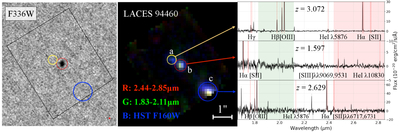
Caption: Figure 2.
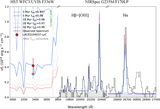
HST and JWST observations of LACES94460. LEFT: HST WFC3/UVIS F336W image obtained by the LACES program (HST-GO-14747, PI: Robertson, T. J. Fletcher et al. 2019). The black box marks the FoV of the JWST NIRSpec IFU G235M/F170LP observations acquired by JWST-GO-1827 (PI: Kakiichi). Middle: three-color composite image with the HST F160W imaging as the blue channel and the JWST IFU data as the green and red channels. Right: optimally extracted 1D spectra at z = 3.072 (LACES94460-a), z = 1.597 (LACES94460-b), and z = 2.629 (LACES94460-c), with the corresponding emission lines highlighted. LACES94460 was previously identified as a silver LyC-leaking candidate at z ∼ 3.1 by T. J. Fletcher et al. (2019), based on its highly significant F336W detection spatially offset from the UV continuum and its strong rest-optical oxygen lines confirmed by ground-based spectroscopy (LACES94460-a, K. Nakajima et al. 2020). However, our analysis demonstrates that the apparent F336W signal instead originates from a nearby low-redshift interloper, LACES94460-b at z = 1.6, located within 0﹩\mathop{.}\limits^{{\unicode{x02033}}}﹩5. This result highlights the critical importance of subkiloparsec-resolution spectroscopy for reliably identifying LyC leakers at high redshifts and for removing contamination from closely projected low-redshift sources.
Other Images in This Article
Copyright and Terms & Conditions
© 2026. The Author(s). Published by the American Astronomical Society.

