

Image Details
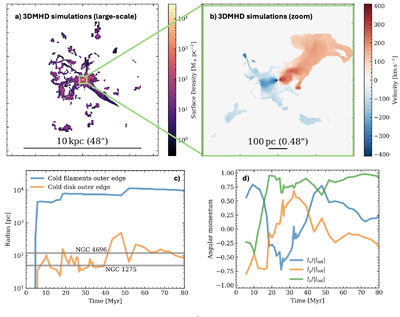
Caption: Figure 2.
Top panels: (a) snapshot of projected large-scale 3D MHD simulated filament network. (b) Snapshot of 3D MHD simulated velocity field within an NIRSpec/IFU FOV, showing only cool gas with a surface density greater than 1% of the maximum. Both snapshots shown in panels (a) and (b) corresponds to t = 40 Myr of the 3D MHD simulations. Bottom panels: (c) evolution of the outer radius of the kiloparsec-scale filaments (blue) and the cool (∼104−5 K) CND (orange) as a function of time. We define the CND size as the radius at which the spherically averaged angular momentum of the cool gas drops below 95% of the Keplerian value. The filaments rapidly expand to kiloparsec scales and remain relatively stable, while the CND exhibits variability, with episodic growth and contraction on ∼10–100 pc scales. The disk sizes of the CND in NGC 4696 (this work) and NGC 1275 (T. Oosterloo et al. 2024) are also shown. (d) Same as panel (c), but tracing the evolution of the orientation of the CND as traced by its angular momentum direction along three different projections.
Other Images in This Article
Copyright and Terms & Conditions
© 2026. The Author(s). Published by the American Astronomical Society.

