

Image Details
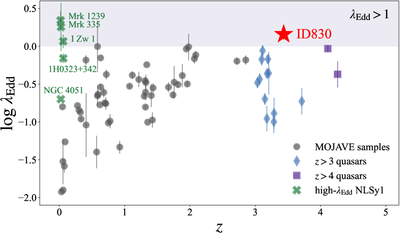
Caption: Figure 4.
Redshift z versus Eddington ratio λEdd. All sources shown in the figure are nonblazar objects with parsec-scale resolved core–jet structures and well-determined Eddington ratios. ID830 is shown as a red star, lying within the shaded region corresponding to the super-Eddington regime (λEdd > 1). The gray circles, blue diamonds, and purple squares indicate the MOJAVE sample (M. L. Lister et al. 2018), z > 3 quasars (Y. Sotnikova et al. 2021, 2024), and z > 4 quasars (M. Krezinger et al. 2022), respectively. The Eddington ratios are compiled from the following studies: SDSS DR14 (S. Rakshit et al. 2020), SDSS DR16 (Q. Wu & Y. Shen 2022), B. Chai et al. (2012), M. Sikora et al. (2007), and C. Tadhunter et al. (2003). For z > 2 samples with C IV-based MBH and λEdd estimates, we apply individual corrections based on the C IV blueshift velocities (L. Coatman et al. 2017), since C IV-based measurements are often biased due to strong outflows. Additionally, some high-λEdd NLS1s are plotted as green cross markers (Mrk 1239: A. Doi et al. 2015; X. Pan et al. 2021; Mrk 335: X. Yang et al. 2020; S. Yao et al. 2021; A. Wang et al. 2023a; A. Wang et al. 2023b; I Zw 1: D. R. Wilkins et al. 2017; A. Wang et al. 2023a; A. Wang et al. 2023b; X. Yang et al. 2024; 1H 0323+342: H. Landt et al. 2017; D. Kynoch et al. 2018; K. Hada et al. 2018; NGC 4051: K. D. Denney et al. 2009; M. Giroletti & F. Panessa 2009; W. Yuan et al. 2021).
Other Images in This Article
Copyright and Terms & Conditions
© 2026. The Author(s). Published by the American Astronomical Society.

