

Image Details
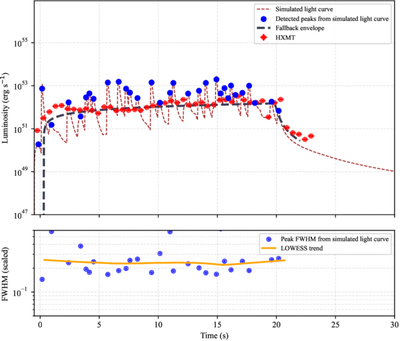
Caption: Figure 4.
Simulation of prompt emission variability under a mass-driven scenario for GRB 250706B/C. The rising luminosity envelope, L(t) ∝ t0.5, results from shells ejected at roughly constant intervals with increasing mass, m ∝ tβ, due to fallback accretion. Although the FWHM is not explicitly shown, the model predicts roughly constant characteristic pulse widths with no strong secular evolution across the burst; individual pulses fluctuate around this baseline, consistent with the observed ensemble behavior. The model separates the long-timescale envelope evolution from the short-timescale pulse variability, consistent with the statistical stationarity of the measured pulse widths and waiting times. This realization shows that a mass-driven process can reproduce the secular luminosity rise and the fine-scale temporal variability of the burst.
Other Images in This Article
Copyright and Terms & Conditions
© 2026. The Author(s). Published by the American Astronomical Society.

