

Image Details
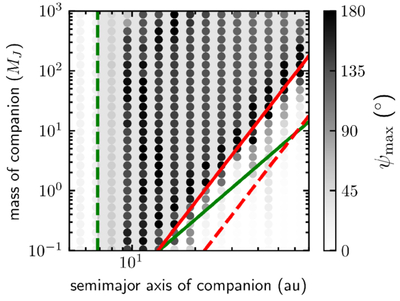
Caption: Figure C1.
Results of the ensemble of secular simulations. The semimajor axis of the intermediate companion X is shown on the x-axis, and its mass is shown on the y-axis. The color scale indicates the maximum obliquity attained by the observed planet b. In all simulations, the initial inclination between the planets and the M dwarf companion is set to 50°. Analytical expressions delineating the different dynamical regimes are shown as solid and dashed lines. See the text for a detailed explanation. We use the following initial conditions to run these simulations: ab = 0.165 au, eb = 0.05, eX = 0.1, ibX = 2﹩\mathop{.}\limits^{\unicode{x000b0}}﹩6, and iXB = 56°. The initial spin periods of the host star and the observed planet are taken to be 22 days and 0.5 days respectively. The initial obliquities of the planets are set close to zero (=0.025). The viscous dissipation timescales of the star and the planet are set to 50 yr and 0.1 yr, respectively. Meanwhile, the Love numbers of the star and the observed planet are set to k2,0 = 0.028 and k2,p = 0.5, respectively.
Other Images in This Article
Copyright and Terms & Conditions
© 2026. The Author(s). Published by the American Astronomical Society.

