

Image Details
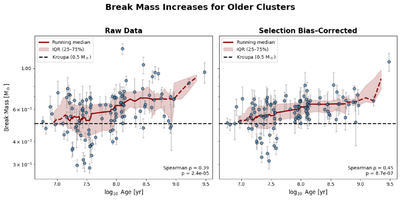
Caption: Figure 5.
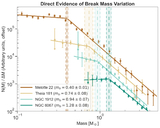
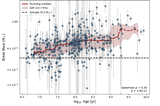
(Left) The break mass observed in Gaia clusters (points, with running median and interquartile range in red, dashed for few clusters in window) increases with cluster age. (Right) As expected, selection biases artificially steepened the slope and added scatter. After correcting for the bias, the slope decreases but the correlation strengthens, revealing the true underlying break mass–age relation. The trend is consistent with the sound speed evolution of a typical galaxy (C. L. Steinhardt et al. 2023c), which will produce an increasing break mass for older clusters. A Kroupa IMF (dashed), defined to have a break mass of 0.5M⊙, is shown for comparison.
Other Images in This Article
Copyright and Terms & Conditions
© 2026. The Author(s). Published by the American Astronomical Society.

