

Image Details
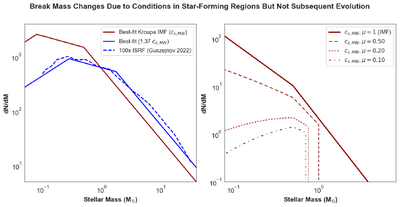
Caption: Figure 1.
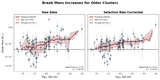
(Left) Theory predicts (blue, solid) that an increase in the sound speed shown with a 37% increase will increase the break masses compared with a Kroupa IMF (red) for typical Galactic sound speeds cs,MW but not the slopes (C. Low & D. Lynden-Bell 1976; R. B. Larson 1985; A. S. Jermyn et al. 2018). A simulation increasing the input stellar radiation field (ISRF) by a factor of 100 (D. Guszejnov et al. 2022) (blue, dashed) shows a similar increase in break masses, although the temperatures and sound speed within the simulated cloud exhibit a complex profile rather than a single value. (Right) Evolution of the stellar mass function over time (dashed) for an open cluster with a Kroupa IMF (solid) at cs,MW, showing the effects of tidal stripping and stellar evolution, based on the semianalytical approximations in H. J. G. L. M. Lamers et al. (2013) (see also M. Gieles & H. Baumgardt 2008; S. F. Portegies Zwart et al. 2010; H. J. G. L. M. Lamers et al. 2013). The time required for individual clusters to reach remaining mass fractions of μ = 0.5, 0.2, and 0.1 will vary depending upon cluster parameters. The slopes and high-mass cutoff evolve over time, but the break mass is not affected. Thus, an observed change in break mass must be due to the IMF rather than subsequent evolution.
Other Images in This Article
Copyright and Terms & Conditions
© 2026. The Author(s). Published by the American Astronomical Society.

