

Image Details
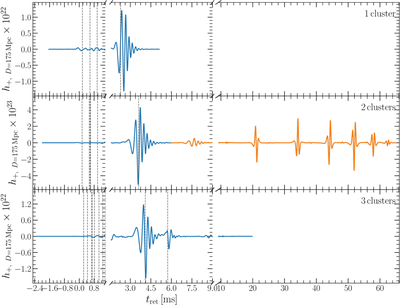
Caption: Figure 3.
Detector-frame plus polarization strain h+ for the three simulations, reconstructed from the extracted waveform at r = 80 M and scaled to a fiducial distance of D = 175 Mpc. The horizontal axis shows retarded time and uses a broken layout to separate the early, intermediate, and late merger episodes. Vertical dashed lines mark the refined merger times during the evolution, and orange color denotes the final eccentric inspiral. Initially the merger of smaller fragments proceeds rapidly, followed either by the final merger in the case of one cluster, or by the formation of the final binary system, consisting of the primary central black hole and the hierarchically assembled secondary, which is subsolar-mass in the case of the two-cluster simulation. This inspiral is highly eccentric, as can be seen from the pulse-like waveform signal prior to the final merger. The three-cluster simulation has a final orbital period longer than what we simulate here, and the single cluster system has completely merged already.
Other Images in This Article
Copyright and Terms & Conditions
© 2026. The Author(s). Published by the American Astronomical Society.

