

Image Details
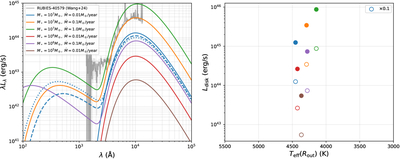
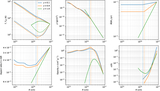
Caption: Figure 7.
Left: example SEDs for selected α = 0.01 disk models by integrating blackbody emission over each disk annulus. All solid lines assume γ = 1, while the dashed and dotted lines correspond to the ﹩{M}_{\bullet }=1{0}^{7}{M}_{\odot },\dot{M}=0.01{M}_{\odot }\,{\mathrm{yr}}^{-1}﹩ model with γ = 0.5, 0.1, respectively, which allows for more UV radiation from the inner AGN disk. We vary ﹩\dot{M},{M}_{\bullet }﹩ , and not α since we expect from Equation (11) that disks with similar ﹩\dot{M}/\alpha ﹩ at a given M• will have similar emission, so that they can be scaled to higher viable α values easily. A representative LRD spectrum (RUBIES-UDS 40579) is plotted in gray. Right: disk luminosity vs. Teff(Rout) for different ﹩\dot{M},{M}_{\bullet }﹩ parameters, with hollow symbols being scaled by 0.1× to naively demonstrate effects of the viewing angle. The self-gravitating disk naturally shows a “Hayashi limit.”
Other Images in This Article
Copyright and Terms & Conditions
© 2026. The Author(s). Published by the American Astronomical Society.

