

Image Details
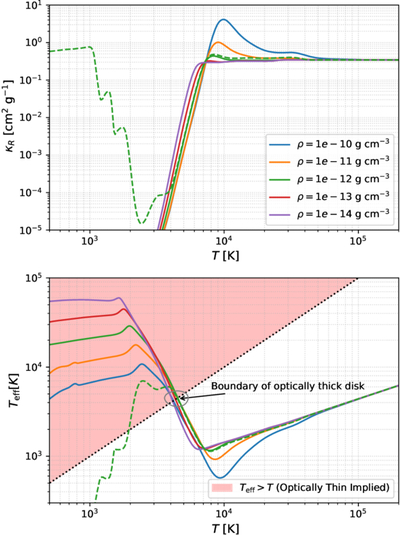
Caption: Figure 2.
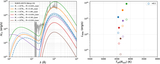
Top panel: solid lines indicate metal-free (Z = 0) Rosseland mean opacities κR(T) for different densities ρ. A representative κR(T) profile for solar metallicity opacity with dust for ρ = 10−12 g cm−3 is shown as a green dashed line for comparison. Lower panel: effective temperature calculated by Equation (4) for different densities. The shaded region represents solutions with Teff > T that are no longer consistent with the optically thick assumption, implying a stellar-UV rather than thermalized emission. For Z = 0 opacities, there is a unique and universal transition at Teff ≈ T ≈ 4000–5000 K (gray circle), regardless of density.
Other Images in This Article
Copyright and Terms & Conditions
© 2026. The Author(s). Published by the American Astronomical Society.

