

Image Details
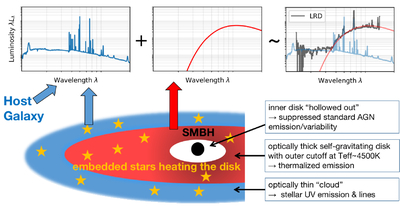
Caption: Figure 1.
Schematic illustration of our proposed physical interpretation of LRDs. The dominant red/optical emission arises from an optically thick, self-gravitating disk with heating primarily supplied by embedded stellar populations (see Section 3). The inner disk is strongly depleted by star formation, suppressing the classical variable UV/X-ray emission from a standard AGN below current observational constraints, although weak residual accretion onto the central source is still allowed (see Section 4). A separate UV component can originate from stellar populations in a surrounding optically thin, diffuse cloud that connects the disk to the nuclear stellar population. The top row shows a schematic spectral decomposition for illustration purposes. We use the observed spectrum of a representative LRD source RUBIES-40579 (B. Wang et al. 2025a) (black lines, top right panel) to illustrate how the total emission may be qualitatively understood as the sum of a thermalized red/optical disk component and a stellar-dominated UV component. This decomposition is not intended as a formal spectral fit, only a visual guide to the proposed physical picture. Although we illustrate the system with a central SMBH, the model also applies to other compact central potentials, such as supermassive stars or dense nuclear stellar clusters. Nevertheless, throughout most of this work, we focus on the SMBH case because it connects more directly, in an evolutionary sense, to the standard quasar population.
Other Images in This Article
Copyright and Terms & Conditions
© 2026. The Author(s). Published by the American Astronomical Society.

