

Image Details
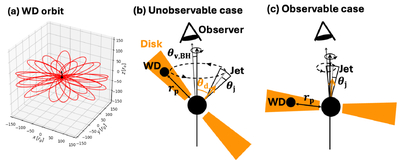
Caption: Figure 1.
Our physical picture for GRB 250702B. Panel (a) shows the geodesic orbit of the WD, where the red line represents our numerical result with a = 30 R⊙, e = 0.97, MBH = 1 × 10⁵ M⊙, aspin = 0.9, and ﹩{\theta }_{{\rm{\min }}}=0.12\,{\rm{rad}}﹩ (7∘). The BH spin axis is indicated by the vertical black line. The orbit exhibits relativistic precession. Mass loss from the WD is not included in this calculation. Panel (b) illustrates an unobservable configuration. An accretion disk forms with its angular-momentum vector tilted by an angle θd with respect to the BH spin axis. As a result, the jet undergoes Lense–Thirring precession. If ∣θv,BH − θd∣ > θj, the jet does not intersect the line of sight, and the prompt emission remains unobservable. Panel (c) shows an observable configuration. If ∣θv,BH − θd∣ ≲ θj, the jet remains continuously observable throughout the Lense–Thirring precession.
Other Images in This Article
Copyright and Terms & Conditions
© 2026. The Author(s). Published by the American Astronomical Society.

