

Image Details
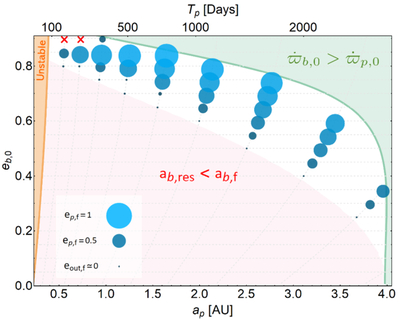
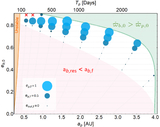
Caption: Figure 2.
Parameter space in the ap − eb,0 plane showing the regime for resonance capture and advection during the orbital decay of the stellar binary. We consider coplanar configurations for all simulations presented in this figure. The orbital period Tp for planets at different distances is labeled at the top. We choose the same stellar binary as in Figure 1, varying only the initial binary eccentricity eb,0. The orange region marks systems that are dynamically unstable according to Equation (9) by considering initially circular planetary orbits. The initial orbits of the planets are spaced according to the mutual Hill instability criterion with Kc = 10 in Equation (10). The green region corresponds to systems in which the initial apsidal precession rate of the inner binary exceeds the precession rate of the planetary orbit. The pink region represents systems for which the binary semimajor axis never shrinks to the value required to trigger apsidal precession resonance before tidal decay ceases. Systems in the green and pink regions would not experience resonance during the binary orbital decay. For each planetary orbit, we integrate the SA secular equations until tidal evolution ends and record the final eccentricity ep,f, whose value is represented by the size of the circles. The red crosses indicate orbits that become unbound in the numerical integration—either the semimajor axis turns negative or the eccentricity exceeds unity.
Other Images in This Article
Copyright and Terms & Conditions
© 2026. The Author(s). Published by the American Astronomical Society.

