

Image Details
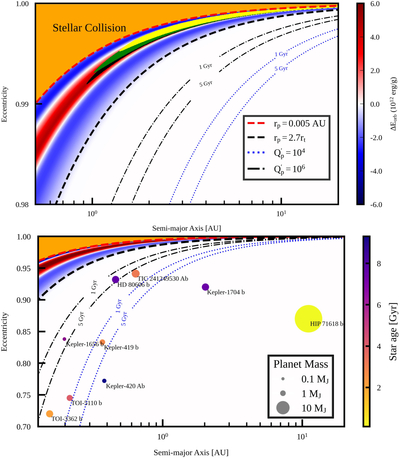
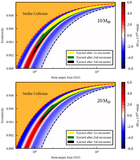
Caption: Figure 5.
Semimajor axis versus eccentricity diagram for high-eccentricity exoplanets, based on our simulation results for planets with a 10 M⊕ core. Overlaid are contours of constant tidal circularization time for 1 and 5 Gyr, computed for a Jupiter-mass planet with Jupiter’s radius, for two representative values of the tidal dissipation parameter: ﹩{Q}_{{\rm{p}}}^{{\prime} }=1{0}^{4}﹩ (blue dotted line) and ﹩{Q}_{{\rm{p}}}^{{\prime} }=1{0}^{6}﹩ (black dashed–dotted line). The lower panel extends to e ≳ 0.7 and overlays observed exoplanets with known masses, radii, and host-star ages (retrieved from the Extrasolar Planets Encyclopaedia (http://exoplanet.eu/) on 2025 December 28). Point sizes are proportional to planetary mass, and colors indicate stellar age in Gyr. Planets located near or within the circularization contours may achieve tidal circularization within the stellar age, while those far outside the contours are likely to remain stalled in their eccentric orbits.
Other Images in This Article
Copyright and Terms & Conditions
© 2026. The Author(s). Published by the American Astronomical Society.

