

Image Details
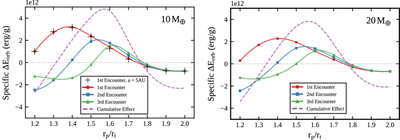
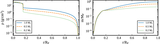
Caption: Figure 3.
Specific orbital energy change ΔEorb as a function of normalized pericenter distance rp/rt for planets with 10 M⊕ (left) and 20 M⊕ (right) cores (a = 1 au). Colored symbols show the energy change after the first (red circles), second (blue squares), and third (green triangles) encounters. The discrete data points are connected by cubic spline interpolations to illustrate the trend. The horizontal dashed line marks ΔEorb = 0, separating orbital energy gain (above) from loss (below). For both core masses, the peak of positive energy shifts toward larger rp/rt with successive encounters, and the three curves converge as rp/rt → 2.0, where mass loss becomes negligible. The black cross in the left panel shows a validation run with a = 5 au (all other parameters fixed), confirming that ΔEorb is insensitive to semimajor axis for highly eccentric orbits.
Other Images in This Article
Copyright and Terms & Conditions
© 2026. The Author(s). Published by the American Astronomical Society.

