

Image Details
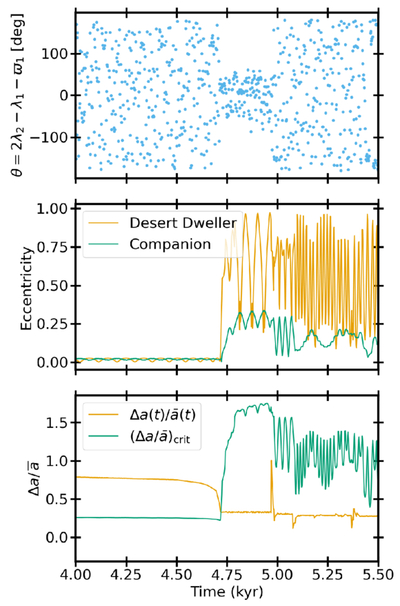
Caption: Figure 4.
A representative example of orbital instability caused by RLO, with Mcore = 10M⊕. Top to bottom panels: resonant argument associated with the 2:1 commensurability, eccentricity of desert dweller (orange) and companion (green), and planet–planet orbital separation normalized by the mean (﹩{\rm{\Delta }}a/\bar{a}=2({a}_{2}-{a}_{1})/({a}_{2}+{a}_{1})﹩) for the planet pair (orange) and the threshold for Hill stability (﹩{({\rm{\Delta }}a/\bar{a})}_{{\rm{crit}}}﹩, in green; following Equation (G.16) of S. Tremaine 2023). The desert dweller’s orbital expansion during mass loss establishes a mean motion resonance, pumping eccentricities to the degree that the planets become Hill unstable. We note that, while our REBOUND calculations successfully track the onset of this instability, we do not attempt to follow the planets’ evolution afterward (which would require collision handling, a model of tides, etc.).
Other Images in This Article
Copyright and Terms & Conditions
© 2026. The Author(s). Published by the American Astronomical Society.

