

Image Details
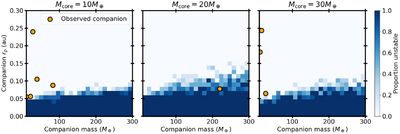
Caption: Figure 3.
Heat map recording proportion of synthetic systems that are unstable after the inner hot Jupiter undergoes RLO. Each system consists of an outer companion of varying periapse distance (rp, y axis) and mass (x axis), with an inner hot Jupiter that undergoes RLO. Panels use a hot Jupiter of core mass Mcore = 10, 20, 30 M⊕ from left to right, respectively. Orange markers indicate the parameters of several observed desert dweller companions (see Table 1) and are placed on the panel with core mass closest to the system’s desert dweller mass (we ignore the desert dweller’s low-mass atmosphere). The observed companion TOI-1347 b (mass 9M⊕) lies just below the lower bound of our sample 10M⊕. The instability threshold moves outward with increasing companion mass, hot Jupiter core mass, and final orbital distance of the hot Jupiter remnant (set by its pre-RLO entropy and core mass; see Figure 1). Outer companions to desert dwellers must lie at distances ≳0.05 au (orbital period ∼4 days) to remain stable; desert dwellers must be alone in the desert if they form via RLO.
Other Images in This Article
Copyright and Terms & Conditions
© 2026. The Author(s). Published by the American Astronomical Society.

