

Image Details
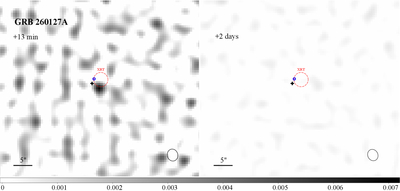
Caption: Figure 1.
Left: image from SMA observations of GRB 260127A on January 27 (10 minute observation). A single point-source-like feature at high significance (4.2σ) is seen, near the reported X-ray and optical afterglow positions, as measured by Swift/XRT (dashed red circle; 90% error radius) and LCO (solid blue circle). There is a faint (g ∼ r ∼ 23 mag) cataloged source in the Legacy Survey (A. Dey et al. 2019), with an extended morphology, 1﹩\mathop{.}\limits^{\unicode{x02033}}﹩3 from the optical position and 2﹩\mathop{.}\limits^{\unicode{x02033}}﹩2 from the SMA position (marked with a plus sign). The synthesized beam is shown in the lower right, with size 3﹩\mathop{.}\limits^{\unicode{x02033}}﹩2 × 2﹩\mathop{.}\limits^{\unicode{x02033}}﹩8 (position angle (PA): 14﹩\mathop{.}\limits^{\unicode{x000b0}}﹩8). Right: image from the January 29 SMA observations (4 hr observation). No significant source is seen around the position of GRB 260127A, nor are any significant sources of emission seen within the field of view of the telescope. Note that the noise level in this image is much lower than that from the January 27 data due to increased observing time and better weather conditions. The synthesized beam is similar to the first observation (3﹩\mathop{.}\limits^{\unicode{x02033}}﹩1 × 2﹩\mathop{.}\limits^{\unicode{x02033}}﹩7; PA: 27﹩\mathop{.}\limits^{\unicode{x000b0}}﹩1).
Other Images in This Article
Copyright and Terms & Conditions
© 2026. The Author(s). Published by the American Astronomical Society.

