

Image Details
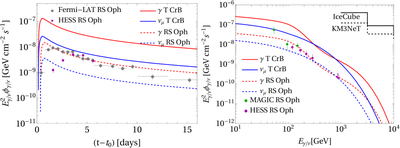
Caption: Figure 1.
Left: gamma-ray flux as a function of time (red) integrated in the energy range 50 MeV–500 GeV for RS Oph using the ES model. The gray data points show the Fermi-LAT measurements (S. De Wolf et al. 2022) in the same energy range, whereas the dark-magenta data points depict the HESS data. The Fermi-LAT data are normalized by a factor of 0.003 as we do not consider the leptonic emission. Right: gamma-ray (red) and muon neutrino (blue) fluxes for RS Oph at distance 2.45 kpc. The green and dark-magenta data points show the MAGIC (V. A. Acciari et al. 2022) and HESS (S. De Wolf et al. 2022) data, respectively. The black contour shows the IceCube sensitivity. The muon neutrino flux (blue curve) being far below the IceCube sensitivity explains the nondetection of neutrinos from RS Oph. For both panels, all the model parameters are given in the benchmark values in Table 1, except ϵp, which is taken to be 0.05.
Other Images in This Article
Copyright and Terms & Conditions
© 2026. The Author(s). Published by the American Astronomical Society.

