

Image Details
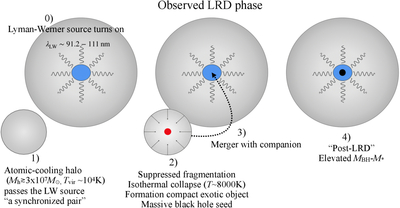
Caption: Figure 5.
Cartoon illustrating a plausible formation and evolutionary pathway for LRDs. A nearby LW radiation source (0) suppresses gas fragmentation in a neighboring atomic-cooling halo (1), enabling its rapid collapse. Under such conditions, the collapsing gas can form an exotic compact object (2) through phases such as a supermassive star or quasi-star, ultimately growing into a massive black hole seed of order 105−106 M⊙ (i.e., a DCBH; see references in Sections 1 and 5), observed as an LRD. The compact red source thus forms offset from a UV-bright companion that provides the LW radiation field (2), likely in a lower-mass satellite halo (see Section 5), producing a configuration consistent with the morphologies observed in ≳43% of LRDs. As the system evolves, the halos may merge (3), while the system may continue to be identified as an LRD as long as it retains a compact, red appearance, before transitioning into a more typical galaxy–AGN system (4). This pathway may represent a key channel for the formation of LRDs, as well as the seeds of the supermassive black holes observed in the local Universe.
Other Images in This Article
Copyright and Terms & Conditions
© 2026. The Author(s). Published by the American Astronomical Society.

