

Image Details
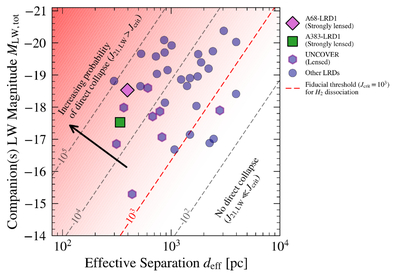
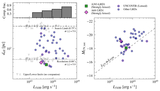
Caption: Figure 4.
The total LW magnitude of the companion(s), MLW,tot, is shown as a function of the effective projected separation from the compact red component, deff (defined such that ﹩{L}_{{\rm{LW}},{\rm{tot}}}/{d}_{{\rm{eff}}}^{2}={\sum }_{i}{L}_{{\rm{LW}},i}/{d}_{i}^{2}﹩ when an LRD has multiple companions). Diagonal lines indicate constant LW radiation intensity, J21,LW, incident on the red component. Systems toward the upper left correspond to brighter companions at smaller separations and therefore higher LW intensities. The red dashed line marks a commonly adopted critical threshold for molecular hydrogen dissociation (Jcrit = 103), above which fragmentation is expected to be strongly suppressed. Shaded regions illustrate increasing likelihood for collapse in an LW-regulated regime.
Other Images in This Article
Copyright and Terms & Conditions
© 2026. The Author(s). Published by the American Astronomical Society.

