

Image Details
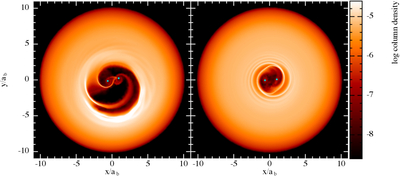
Caption: Figure 1.
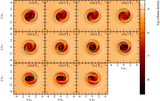
Column density profiles for prograde (left) and retrograde (right) circumbinary disks once they have each reached a quasi-steady state. In each panel, the left cyan point represents the primary, and the right cyan point represents the secondary. In the prograde case, we see a large inner cavity has been evacuated, which is punctuated by a stream that feeds the circumprimary disk. The strongest density enhancement in this case occurs at a radius of around 4–5 ab. In the retrograde case, the disk extends much closer to the binary with a ring-like structure occurring at around 2 ab with a thickness of around 0.5 ab. The retrograde disk structure is in better agreement with the observations for DX Cha.
Other Images in This Article
Copyright and Terms & Conditions
© 2026. The Author(s). Published by the American Astronomical Society.

