

Image Details
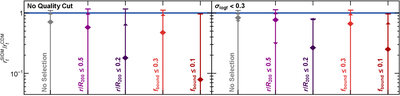
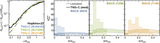
Caption: Figure C1.
Ratios of subhalo tidal radii computed from CDM–SIDM-matched pairs of the L-Cluster run of the SIDM Concerto suite (E. O. Nadler et al. 2025) that assumes a Rutherford-like velocity-dependent cross-section model (see the text for details). We show the mean (diamonds), central 68% (triangles), and central 95% (horizontal bars) ranges of each distribution under no subhalo selection (gray) and as selected by instantaneous halocentric radius (purple) or bound mass fraction (red). This comparison is done for the entire CDM–SIDM-matched subhalo sample (left) and for the subsample filtered by requiring the mass-resolution-limited numerical scatter in the bound mass fraction to be less than 0.3 dex (right; Equation (C1)). Even in the mildly collisional regime or with velocity-dependent SIDM models, self-interaction-driven core formation leads to substantially higher tidal mass loss and tidal truncation radii statistically discrepant from CDM predictions, by up to an order of magnitude for inner and/or heavily stripped subhalos.
Other Images in This Article
Copyright and Terms & Conditions
© 2026. The Author(s). Published by the American Astronomical Society.

