

Image Details
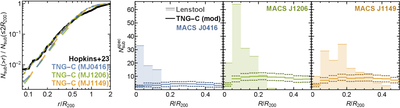
Caption: Figure B1.
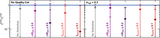
Left: 3D radial distribution of the subhalos in our TNG-C cluster analogs (dashed, color-coded as indicated) compared to the force-disruption-free benchmark taken from P. F. Hopkins et al. (2023; black solid). We show the cumulative number of all subhalos with more than 20 DM particles, normalized to the total number within the respective 2R200. To explicitly account for the artificial disruption of the inner subhalos, we artificially “inject” subhalos within 0.5R200 by sampling weighted by the deficit within 0.5R200 between the TNG-C and benchmark cumulative distributions (see the text for details). Three random examples of such modified subhalo radial distributions (dotted) are plotted that well match the benchmark distribution. Right: projected radial distribution of the subhalos hosting member galaxies in observed clusters (color-shaded, as in the top panel of Figure 2) and in simulated analogs with injected inner subhalos. The solid (dotted) lines show the mean (1σ confidence interval) inferred from 1 million bootstrapping iterations. Within the projected radius of ≲0.2R200, individual radial bins remain 5σ–40σ discrepant with the observed abundance, even after explicitly accounting for numerical uncertainties due to artificial disruption.
Other Images in This Article
Copyright and Terms & Conditions
© 2026. The Author(s). Published by the American Astronomical Society.

