

Image Details
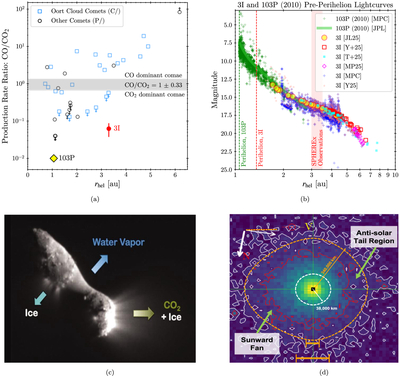
Caption: Figure 4.
(a) Ratios of CO/CO2 gas production rates of solar system comets (O. Harrington Pinto et al. 2022). CO vs. CO2 dominated comets are separated on this plot by a criterion of 1 ± 0.33, indicated by the shaded horizontal band (O. Harrington Pinto et al. 2022). The ratio of 3I makes it extremely CO-poor and equivalent to the most thermally processed comet in the 2022 survey, 103P. (b) Pre-perihelion optical lightcurves observed for comet 103P during the 2010–2011 apparition and 3I in 2025 May–October. Published data (D. Jewitt & J. Luu 2025; J. Tonry et al. 2025; Q. Ye et al. 2025) have been shifted to match the absolute magnitude from the Minor Planet Center Database (https://www.minorplanetcenter.net/db_search/show_object?object_id=3I for 3I and (https://www.minorplanetcenter.net/db_search/show_object?object_id=103P) for 103P), the T-mag from JPL Horizons ephemerides service (https://ssd.jpl.nasa.gov/horizons/app.html), and the data kindly shared by S. Yoshida (2025 private communication; http://www.aerith.net/comet/catalog/0003I/2025N1.html). There is very good agreement between the two inbound lightcurve trends. An inherent spread of ∼0.5 mag in the measurements between nights and between observers can be seen. (c) Close flyby imaging of the ∼1.5 × 0.6 × 0.6 km nucleus of comet 103P as obtained by the Deep Impact Extended mission (M. F. A’Hearn et al. 2011). A marked bilobate nuclear morphology was seen, with unusually large (10–3–10–1 m) chunks of CO2-rich ice and gas emanating from the end of the smaller lobe and the middle of the larger lobe. The surrounding coma, filled with large long-lived icy grains, was found to be at least five times brighter and more actively emitting gas than the nucleus. While the nucleus of 3I has never been resolved, given its similar behavior, it could possibly share similar morphological characteristics. (d) Schematic of the 3I object derived from SPHEREx CO2 photometric mapping. The <2.5 km radius nucleus (D. Jewitt et al. 2025) was not resolved at the SPHEREx pixel scale of 6﹩\mathop{.}\limits^{\unicode{x02033}}﹩15 ≈ 11,600 km at 2.6 au distance, but a notional image of the nucleus has been included at the origin to give the reader its location and a sense of scale. Two distances have been marked: the ∼38,000 km (white dashed circle) inside of which we think coma ice is actively sourcing CO2 by sublimation, and ∼340,000 km (orange dashed oval), the minimum radial distance to which we detect CO2 gas at 2σ level.
Other Images in This Article
Copyright and Terms & Conditions
© 2026. The Author(s). Published by the American Astronomical Society.

