

Image Details
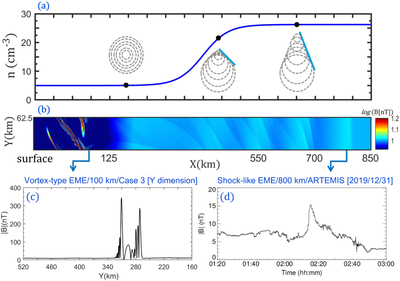
Caption: Figure 4.
From boundary-layer vortices to high-altitude shocks: extended KHI evolution under slow solar wind. Extended simulations of the slow-solar-wind Case 3 incorporate an upward-increasing plasma density, as shown in panel (a). The KHI develops only near the minimagnetopause, where vortex ridges act as disturbed sources of fast-mode waves that propagate upward from the boundary layer. The three schematic insets illustrate how these fast-mode waves (gray dashed circles) propagate into regions of higher density (black dots), where the reduction in fast-mode speed enables constructive interference and the formation of secondary shocks (blue lines). Panel (b) presents the color-level plot of simulation results, showing secondary fast-mode shocks extending above 400 km in altitude, with a flaring angle that narrows with height. Panel (c) shows the simulated near-surface magnetic field profile from the vortex-dominated Case 3 at 100 km altitude, illustrating how boundary-layer vortices can generate large-amplitude, highly oscillatory EMEs—with peak fields reaching ∼350 nT (∼35 times the ambient solar-wind value)—when sampled close to the minimagnetopause. Panel (d) displays a representative high-altitude lunar EME observed by ARTEMIS at ∼800 km above the antipodes of Imbrium, Serenitatis, and Crisium (L. Xie et al. 2022), with a peak enhancement of ∼2–3 times the upstream field, consistent with the scenario in which upward-propagating fast-mode waves from the boundary layer interfere constructively to form remote shock-like EMEs. Together, panels (c) and (d) illustrate how the same KHI-driven mechanism operating near the boundary layer can produce both intense near-surface oscillatory EMEs and moderate high-altitude shock-like EMEs above the Moon.
Other Images in This Article
Copyright and Terms & Conditions
© 2026. The Author(s). Published by the American Astronomical Society.

