

Image Details
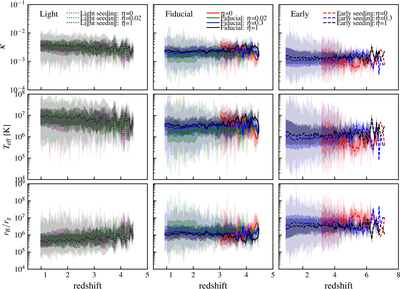
Caption: Figure 3.
The evolution of accretion suppression (top, ﹩\kappa \equiv {\dot{M}}_{{\rm{BH}}}/{\dot{M}}_{{\rm{Bondi}}}﹩), the corresponding gas temperature (middle), and the Bondi radius (bottom) for the light-seeding (left), fiducial-seeding (center), and early-seeding (right) models. The shaded regions show the full distribution and the 16th–84th percentile range. In all cases, the suppression of black hole accretion relative to the Bondi rate falls within ∼10−3–10−2. Higher feedback efficiency produces hotter gas around the black hole and thus larger κ. More massive black holes, resulting from earlier or more massive seeding, lead to broader distributions of κ, temperature, and rB/rg, and systematically lower average κ and temperatures.
Other Images in This Article
Copyright and Terms & Conditions
© 2026. The Author(s). Published by the American Astronomical Society.

