

Image Details
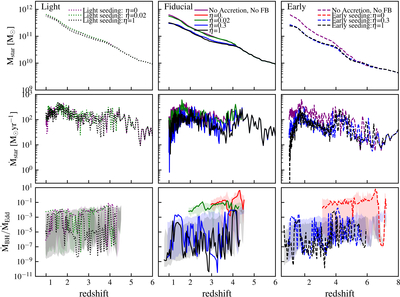
Caption: Figure 2.
The stellar mass (top), star formation rate (middle), and black hole accretion rate (bottom) of the most massive progenitor in the light-seeding (left), fiducial-seeding (center), and early-seeding (right) models. The shaded region shows the 16th–84th percentile range of the accretion rate across all black holes in the run at each time. Black holes with MBH ≲ 107M⊙ do not impact the star formation rate regardless of feedback efficiency. For MBH ≳ 3 × 10⁷M⊙, feedback efficiencies η ≳ 0.3 (a* ≳ 0.9) lead to efficient quenching of star formation, while efficiencies η ≲ 0.02 remain ineffective. A feedback efficiency ≳0.3 always suppresses black hole accretion, regardless of black hole mass.
Other Images in This Article
Copyright and Terms & Conditions
© 2026. The Author(s). Published by the American Astronomical Society.

