

Image Details
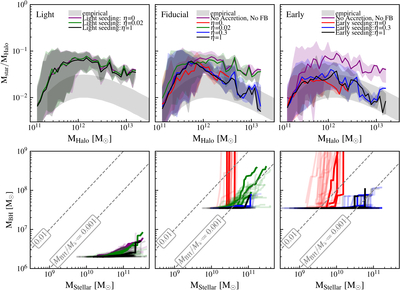
Caption: Figure 1.
Stellar mass–halo mass relation (top) and black hole mass–stellar mass relation (bottom) for the light-seeding (left), fiducial-seeding (center), and early-seeding (right) models. The shaded region, which represents the empirical relation at z = 1 (P. S. Behroozi et al. 2010), should be treated as a guide for the eye, as we overplot results from all redshifts. For seed black holes with MBH < 107M⊙, the black hole does not grow, and the galaxy is not quenched, regardless of feedback efficiencies, resulting in excess stellar mass above MHalo ≳ 1012M⊙. In the fiducial seeding case, the black hole overgrows without feedback, grows moderately when the efficiency matches a* = 0 result, and fails to accrete when the efficiency corresponds to maximum spin (η ≳ 0.3); star formation is also quenched in this high-efficiency case. With early massive seeding, black holes still do not grow through accretion for η ≳ 0.3, but growth through mergers can reproduce the observed local black hole–stellar mass relation. Galaxy quenching is also more efficient, yielding better agreement with the local stellar mass–halo mass relation.
Other Images in This Article
Copyright and Terms & Conditions
© 2026. The Author(s). Published by the American Astronomical Society.

