

Image Details
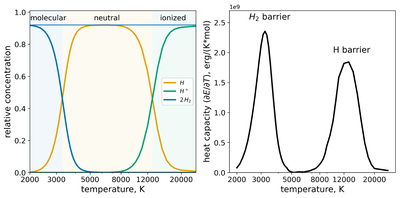
Caption: Figure 2.
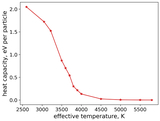
Molecular hydrogen dissociation and atomic hydrogen ionization thermostats in stellar atmospheres. Left panel: relative concentrations of molecular, atomic, and ionized hydrogen, normalized to the total concentration of heavy particles (i.e., all particles except electrons), shown as functions of temperature. The concentration of molecular hydrogen is multiplied by 2 to account for the fact that each molecule consists of two hydrogen atoms. The horizontal blue line indicates the condition where hydrogen exists entirely in a single stage, either molecular, neutral, or ionized. Right panel: isobaric heat capacity. The calculations are performed for solar elemental composition and pressure, ∼0.1 bar, typical for the solar surface. The key message of the figure is that both dissociation and ionization occur over a very narrow temperature range, resulting in two distinct peaks in heat capacity—the H2 and H thermostats.
Other Images in This Article
Copyright and Terms & Conditions
© 2026. The Author(s). Published by the American Astronomical Society.

