

Image Details
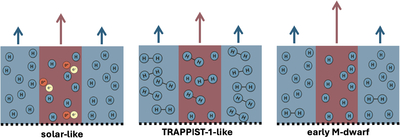
Caption: Figure 1.
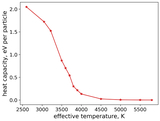
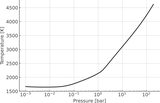
Illustration of flare heating in three types of stars. The dashed line marks the stellar surface; blue areas show the quiet atmosphere, and red areas show regions heated during a white-light flare. Vertical arrows indicate the radiative output, with length proportional to intensity. In solar-like stars (left), heating is regulated by hydrogen ionization, which limits the temperatures of white-light flares to ∼9000 K. In late M dwarfs like TRAPPIST-1 (middle), molecular hydrogen dissociation acts as a thermostat, capping the temperatures of white-light flares near ∼3500–4000 K. In early M dwarfs (right), insufficient concentration of H2 means the dissociation thermostat is ineffective, allowing higher white-light flare temperatures.
Other Images in This Article
Copyright and Terms & Conditions
© 2026. The Author(s). Published by the American Astronomical Society.

