

Image Details
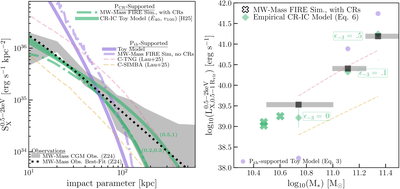
Caption: Figure 3.
Left: analytic and simulated XSB radial profiles in MW-mass halos. The analytic XSB profile for a Pth-supported halo (purple solid line) truncates steeply relative to the Z24a observations (black/grey shaded and dotted line), similarly to the Pth-supported FIRE run (purple dotted–dashed line), whereas fiducial C-TNG (pink dashed line) can match the outer XSB shape and C-SIMBA (gold dashed line) vastly underpredicts the XSB. PCR-supported analytic predictions (green solid, with variations in [Ė40, v100] labeled) can agree with the observed constraints, as also shown by a PCR-dominated simulation (green dot-dashed). Right: total outer CGM soft LX, for ∼L* galaxies, here integrated between 0.5Rvir and 1Rvir. PCR-dominated MW-mass simulations (green crosses) and empirical CR-IC models with varied AGN leptonic injection ϵ−3 (green diamonds; error bars showing 0.3 dex scatter on ﹩\dot{{M}_{* }}﹩) agree with the observed best-fit (black squares; bands showing stacked range in M*), while in agreement with ﹩{\tilde{Y}}_{{\rm{200}}}﹩. Pth-supported analytic predictions (purple circles) underpredict/overpredict LX at low/high M*, C-TNG meets MW and M31 mass constraints but underpredicts at 2M31 mass, whereas C-SIMBA universally underpredicts LX. Unilaterally, all Pth-supported models overpredict ﹩{\tilde{Y}}_{{\rm{200}}}﹩, irrespective of LX predictions (see Figure 2) particularly at low/high masses, but less so at intermediate Mhalo.
Other Images in This Article
Copyright and Terms & Conditions
© 2026. The Author(s). Published by the American Astronomical Society.

