

Image Details
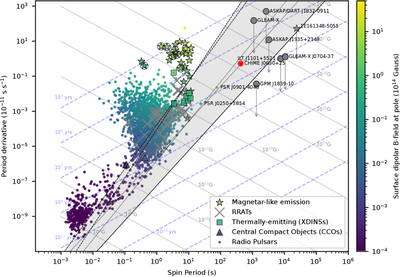
Caption: Figure 4.
﹩P-\dot{P}﹩ diagram. 1E161348–5055, a central compact object that shows evidence of magnetar-like emission, is shown with a gray star (A. D’Aì et al. 2016). The longest-period pulsars PSR J2050+5854 and LPT PSR J0901–4046 are shown by the colored dots and labeled as such. The gray-shaded region shows the death valley for coherent pulsed radio emission. The black dashed line corresponds to a pure dipole, dotted lines to a twisted dipole, and solid lines to a twisted multipole configuration (K. Chen & M. Ruderman 1993; B. Zhang et al. 2000). The blue dashed lines correspond to lines of constant age, and the gray solid lines correspond to lines of constant magnetic field. All downward-facing arrows correspond to upper limits and are at the 1σ level.
Other Images in This Article
Copyright and Terms & Conditions
© 2025. The Author(s). Published by the American Astronomical Society.

