

Image Details
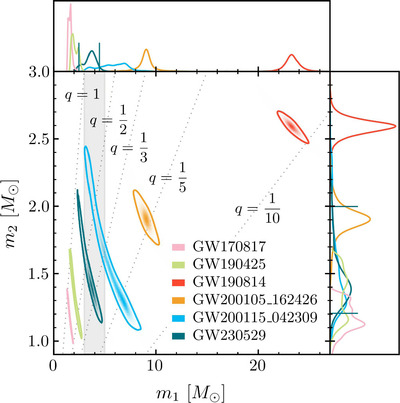
Caption: Figure 1.
The one- and two-dimensional posterior probability distributions for the component masses of the source binary of GW230529 (teal). The contours in the main panel denote the 90% credible regions, with vertical and horizontal lines in the side panels denoting the 90% credible interval for the marginalized one-dimensional posterior distributions. Also shown are the two O3 NSBH events GW200105_162426 and GW200115_042309 (orange and blue, respectively; Abbott et al. 2021a) with FAR < 0.25 yr−1 (Abbott et al. 2023a), the two confident BNS events GW170817 and GW190425 (pink and green, respectively; Abbott et al. 2017a, 2019a, 2020a, 2024b), and GW190814 (red; R. Abbott et al. 2020c; Abbott et al. 2024b), where the secondary component may be a black hole or a neutron star. Lines of constant mass ratio are indicated by dotted gray lines. The gray shaded region marks the 3–5 M ⊙ range of primary masses. The NSBH events and GW190814 use combined posterior samples assuming a high-spin prior analogous to those presented in this work. The BNS events use high-spin IMRPhenomPv2_NRTidal (Dietrich et al. 2019a) samples.
Other Images in This Article
Show More
Copyright and Terms & Conditions
© 2024. The Author(s). Published by the American Astronomical Society.

