

Image Details
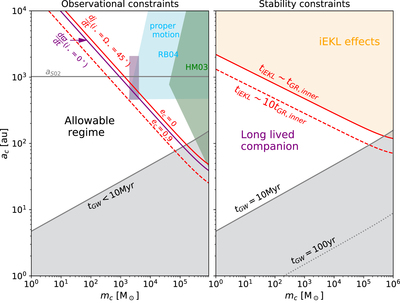
Caption: Figure 3.
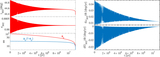
Constraints on the mass-semimajor axis parameter space of a hypothetical companion to Sgr A*. Right panel: we show constraints obtained by requiring that iEKL effects do not induce instabilities in the stellar orbit (yellow region). Below the lines where the iEKL timescales are comparable to or 10 times the GR precession timescale, GR precessions tend to suppress iEKL excitations. The gray region denotes configurations where the GW merger time is shorter than 10 Myr (the dotted line is for a merger time of 100 yr). Left panel: we show observational constraints obtained from the two invariant quantities of Equations (11)–(14). Specifically, we consider the bound on ﹩d{\boldsymbol{j}}﹩/dt, for i⋆ = Ω⋆ = 45° and ec = 0 and ec = 0.9 (solid and dashed red lines, respectively). For dϖ/dt, we show the bound on the square root of the sum of the squares of the two terms in Equation (14), assuming i⋆ = 0° and ec = 0. While i⋆ is an unknown parameter, the two invariant variables have very different dependences on i⋆, enabling us to impose complementary bounds. From these limits, we can already rule out a 105 M⊙ companion in a circular orbit beyond 170 au. We also include constraints imposed by data on the proper motion of Sgr A* (Hansen & Milosavljević, 2003; green), and (Reid & Brunthaler 2004; cyan). We also show the exuded regime from Gualandris & Merritt (2009) N-body integrations of stellar orbits in the presence of a companion, purple rectangle.
Other Images in This Article
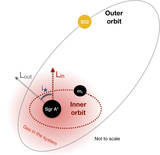
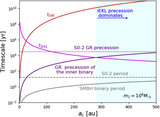
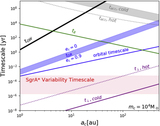
Copyright and Terms & Conditions
© 2019. The American Astronomical Society. All rights reserved.

