

Image Details
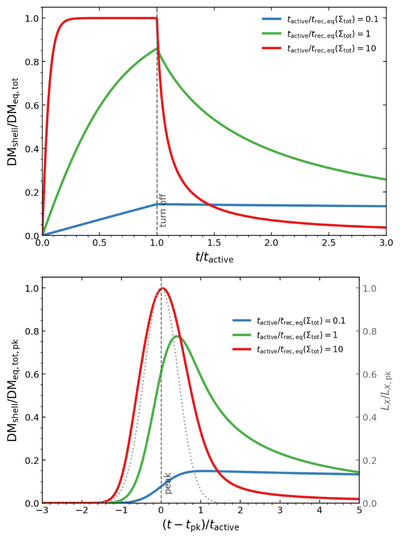
Caption: Figure 2.
Evolution of the DM response during and after finite episodes of ionizing X-ray activity. The top panel shows the analytic solution for an idealized constant-luminosity episode of duration tactive (Equations (37) and (39)); the bottom panel shows the result of numerically solving Equation (35) for a Gaussian luminosity history with FWHM tactive. Curves are labeled by tactive/trec,eq(Σtot) and are normalized to the equilibrium DM corresponding to a steady luminosity equal to the peak luminosity of the episode. The curves may be interpreted as the response of a representative layer near Σ ≃ Σtot, which is a good proxy for the shell-integrated DM because both the equilibrium DM and the initial DM growth rate are weighted toward large columns. For slowly varying luminosity, the DM remains close to equilibrium and tracks ﹩{{\rm{DM}}}_{{\rm{eq}}}\propto {L}_{{\rm{X}}}^{1/2}﹩. For short activity episodes, the DM rises approximately with the accumulated ionizing fluence, reaches only a fraction of DMeq,tot, and then undergoes a slower recombination-powered decline after the luminosity fades.
Other Images in This Article
Copyright and Terms & Conditions
© 2026. The Author(s). Published by the American Astronomical Society.

