

Image Details
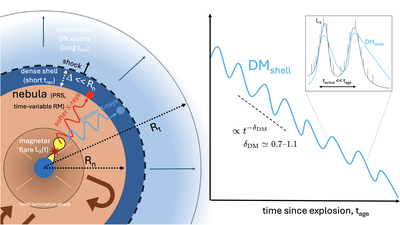
Caption: Figure 1.
Schematic illustration of the photoionization-regulated DM scenario. A central magnetar launches a relativistic wind that is thermalized at a wind termination shock and inflates a magnetized nebula, identified with the persistent radio source (PRS). Turbulence and magnetic-field fluctuations inside the nebula can give rise to the large, time-variable RM, while its secular decline reflects the expansion and dilution of the magnetized nebula confined by the surrounding ejecta (B. Margalit & B. D. Metzger 2018). The nebula drives a forward shock into the freely expanding supernova ejecta, sweeping the inner ejecta into a thin dense shell of thickness Δ ≪ Rn. This dense shell has a short recombination time and is photoionized by the central X-ray luminosity: softer X-rays are absorbed closer to the inner edge, while harder X-rays penetrate to larger columns. The resulting ionized column produces the time-variable shell contribution, DMshell. More extended, unswept ejecta near the transition radius Rt have lower density and longer recombination times and, therefore, contribute mainly to a slowly varying or approximately constant local DM. Right: on the system age, the shell DM declines secularly as the ejecta expand, approximately ﹩{{\rm{DM}}}_{{\rm{shell}}}\propto {t}_{{\rm{age}}}^{-{\delta }_{{\rm{DM}}}}﹩. On shorter activity timescales, tactive ≪ tage, individual magnetar flares and longer active episodes in LX(t) drive a smoothed and delayed DM response as the shell approaches and departs from photoionization-recombination equilibrium.
Other Images in This Article
Copyright and Terms & Conditions
© 2026. The Author(s). Published by the American Astronomical Society.

