

Image Details
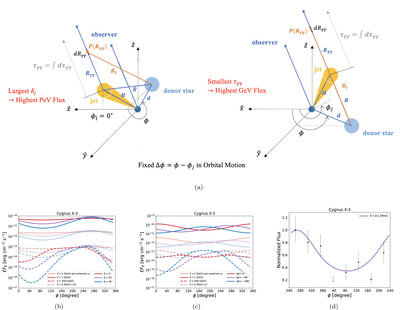
Caption: Figure 7.
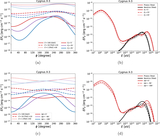
Panel (a) provides a schematic illustration of the adopted deflected or misaligned jet geometry. The values of Δϕ and ϑj are assumed to remain constant throughout the orbital motion. External γγ optical depth is accumulated along the gamma-ray trajectory, with P(Rγγ) marking an arbitrary point along the path. The maximum Doppler factor and the weakest external γγ annihilation occur at different orbital phases, resulting in energy-dependent modulation. Panels (b) and (c) show the fluxes at selected energies for the jet blob with varying ϑj, Δϕ, and orbital phase ϕ. Different line styles correspond to different energy bands. Panel (b) adopts Δϕ = −90∘, whereas panel (c) adopts ϑj = 25∘. In panel (b), different colors indicate varying ϑj, while in panel (c), colors represent different Δϕ, as detailed in the legend. Fainter colors correspond to results calculated without external γγ annihilation. Panel (d) shows the flux above 0.1 PeV as a function of ϕ for Scenario A, for both the jet blob and the inner blob, with ϑj = 25∘ and Δϕ = −90∘, using the same parameters as listed in Tables 2-4. The black points represent the orbital light curve of Cygnus X-3 measured by LHAASO (≥0.1 PeV) (Z. Cao et al. 2026).
Other Images in This Article
Copyright and Terms & Conditions
© 2026. The Author(s). Published by the American Astronomical Society.

