

Image Details
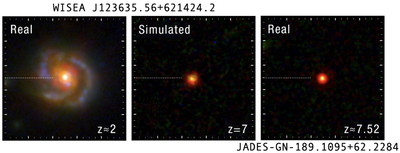
Caption: Figure 6.
Visual demonstration of cosmological surface brightness dimming and its impact on the host galaxy. Left: the real Saguaro (WISEA J123635.56+621424.2) observed at z = 2.0145. Center: the same galaxy artificially redshifted to z = 7 using the FERENGI prescription (M. Barden et al. 2008). Right: a representative LRD at comparable redshift from P. Rinaldi et al. (2025a). All cutouts are 3″ × 3″. The toy experiment demonstrates how the host galaxy becomes increasingly suppressed in its outskirts, while the central regions remain detectable, mirroring the effect observed in LRDs. For these RGB images, we make use of the code TRILOGY (D. Coe) with some customized steps. Briefly, each band is independently scaled using a sigma-clipped estimate of the background and a logarithmic stretch. This scaling is designed to suppress noise-dominated pixels (and thus equalize the background across all images), preserve faint extended emission, and avoid excessive saturation of the brightest regions. The RGBs are based on F444W, F277W, and F090W.
Other Images in This Article
Show More
Copyright and Terms & Conditions
© 2026. The Author(s). Published by the American Astronomical Society.

