

Image Details
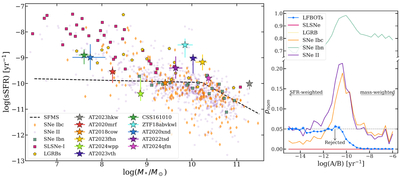
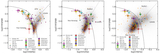
Caption: Figure 3.
Left: the hosts of LFBOTs (stars; lines indicate median and 68% interval), SNe II (purple circles), SNe Ibc (orange diamonds), SNe Ibn (green crosses), SLSNe-I (pink squares), and LGRBs (yellow pentagons) along the SFMS derived in J. Leja et al. (2022) at z < 0.5. LFBOT hosts lie slightly above the SFMS and the CCSNe host populations, and are clearly distinct from LGRB and SLSN-I hosts. Right: the results of the A. Horowicz & B. Margalit (2026) test, which determines if a host galaxy population is drawn from a weighted SFR–M* distribution of a mock field galaxy population. We determine weights from ﹩\mathrm{log}(A/B)﹩, where lower values indicate more SFR-weighted distributions, and higher values indicate more M*-weighted distributions. If pnom < 0.05, we can reject the null hypothesis that the host galaxy sample is drawn from the weighted distribution. We find that LFBOT hosts prefer more SFR-weighted distributions, especially in comparison to the SNe II and Ibc hosts. The stars mark the solutions where the LFBOT 1D SFR and M* distributions were not statistically distinct from those of the weighted distribution. We cannot reject any weighted distributions for SNe Ibn hosts, and we do not find any solution that fits the SFR–M* distributions of LGRB and SLSN-I hosts well.
Other Images in This Article

Copyright and Terms & Conditions
© 2026. The Author(s). Published by the American Astronomical Society.

