

Image Details
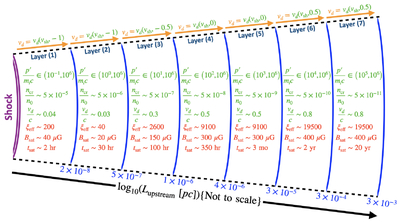
Caption: Figure 10.
Schematic illustration of CR self-confinement via NRSI in a layered upstream ISM plasma ahead of an SNR shock. CRs with ﹩{f}_{{\rm{cr}}}^{{\prime} }(p)\propto {p}^{-4}﹩, produced at the shock, enter an initially unperturbed upstream region and amplify magnetic fluctuations through NRSI. CRs with momenta ﹩{p}^{{\prime} }\in (p{{\prime} }_{{\rm{\min }}}^{(i)},10p{{\prime} }_{{\rm{\min }}}^{(i)})﹩ isotropize in each layer, where ﹩p{{\prime} }_{{\rm{\min }}}^{(i)}﹩ is the minimum momentum in layer (i) (as ﹩p{{\prime} }_{{\rm{eff}}}^{(i)}\sim 10p{{\prime} }_{{\rm{\min }}}^{(i)}﹩ in Equation (20); see Section 4.2.3 for details). Higher-energy particles escape to the next unperturbed region, where they become fresh drivers of NRSI with ﹩p{{\prime} }_{{\rm{\min }}}^{\,(i+1)}﹩ increased by a factor of 10 and reduced number density ﹩{n}_{{\rm{cr}}}^{(i+1)}﹩ compared to layer (i). The CR drift speed ﹩{v}_{d}^{(i)}={v}_{d}({v}_{b},\mu {{\prime} }_{{\rm{\min }}}^{(i)})﹩ depends on the boost speed vb and minimum pitch angle ﹩\mu {{\prime} }_{{\rm{\min }}}^{(i)}﹩ (see Equation (11)). In all layers, vb equals the shock speed vsh (transforming to the upstream plasma rest frame). In furthersuccessive layers, we assume that ﹩\mu {{\prime} }_{{\rm{\min }}}^{(i)}﹩ increases, implying more forward-beamed distributions. After the instability saturates at time ﹩{t}_{{\rm{sat}}}^{(i)}\sim 10/{\gamma }_{{\rm{fast}}}^{(i)}﹩ in layer (i), CRs of higher momenta diffuse to the next layer over a distance comparable to their Larmor radii, i.e., ﹩{\rm{\Delta }}{L}_{{\rm{upstream}}}^{(i)}\sim 10p{{\prime} }_{{\rm{\min }}}^{(i)}c/e{B}_{{\rm{sat}}}^{(i)}﹩.
Other Images in This Article
Show More
Copyright and Terms & Conditions
© 2026. The Author(s). Published by the American Astronomical Society.

