

Image Details
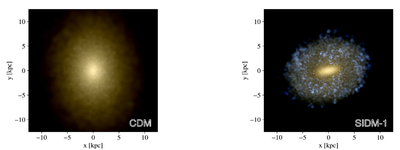
Caption: Figure 1.
One of the simulated galaxies with CDM (left) and SIDM-1 (right), at redshift zero. With CDM, the total mass (gas + stars + dark matter) is 7.24 × 10¹¹ M⊙, the stellar mass is 1.04 × 10¹⁰ M⊙, and the dark matter mass is 6.50 × 10¹¹ M⊙. With SIDM-1, the total mass is 8.73 × 10¹¹ M⊙, the stellar mass is 3.89 × 10¹⁰ M⊙, and the dark matter mass is 7.39 × 10¹¹ M⊙. These masses are calculated using Pynbody, and include all particles that are gravitationally bound to the halo (A. Pontzen et al. 2013). Pynbody uses a stellar population model to estimate the stellar luminosity in different wavelength bands, from which it determines the apparent colors in the images. The colors are set by mapping red, green, and blue to the I (infrared), V (visible), and U (ultraviolet) bands, respectively. Here, the clearly visible differences are primarily due to the effects of SIDM-1 on the star formation history. As SIDM-1 delays the growth of black holes via mergers, star formation is not suppressed to the same degree.
Other Images in This Article
Copyright and Terms & Conditions
© 2026. The Author(s). Published by the American Astronomical Society.

